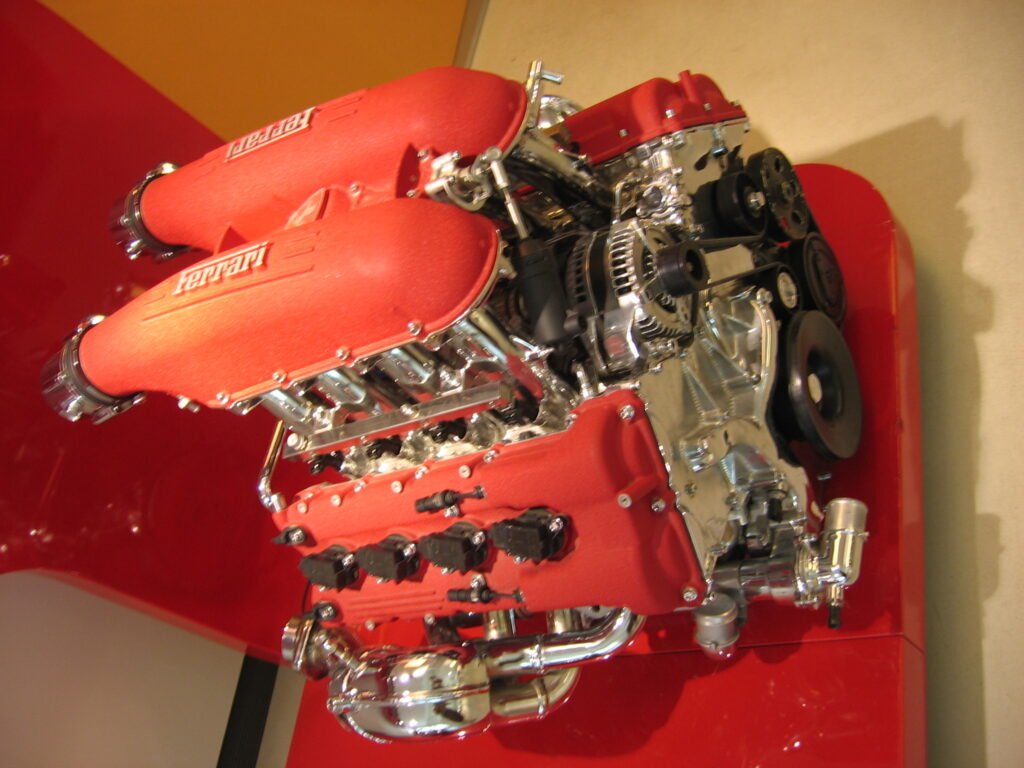
The F136 is the naturally aspirated V8 that took Ferrari from the F430 to the 458 Italia, and went into Maserati and Alfa Romeo cars along the way. It revs to the sky, it sounds like nothing else, and in its 458 form it won engine of the year awards more than once. It is also a hand built Italian racing style engine in a road car, which means it has its own list of weak spots. If you own one, or you are about to buy a car with one, Ferrari F136 engine problems are worth understanding properly.
We are NJ Global Auto Parts. We sell replacement engines, and that includes Ferrari F136 engines, mainly the F136FB from the 458 Italia, plus other versions when we can source them. We ship worldwide to private owners, collectors and specialist workshops. This guide covers the Ferrari F136 engine problems that come up most often, how serious each one is, and what to do when the engine itself is beyond saving.
If you already know you need an engine, see our Ferrari F136FB engine for sale page, or send your VIN and engine number through the contact page.
Ferrari F136 Engine Problems in a Nutshell
The core of the F136 is tough. Forged internals, a stiff aluminium block, a dry sump on the Ferrari versions, and a chain driven valve train, so there is no timing belt service like on the older F355 and 360. Most Ferrari F136 engine problems are not about the engine blowing up. They are about heat, the exhaust side, the cam phasing system on some versions, leaks, and ignition parts.
Version matters a lot. The early 4.3 litre F430 engine has a well known exhaust manifold weakness. The Maserati 4.2 and 4.7 engines have their own reputation for cam variator wear. The 458 Italia F136FB is widely seen as the strongest of the lot. So before you read anything about Ferrari F136 engine problems, know which version you are dealing with.
The F136 Family: Versions and Specifications
Ferrari designed the F136 and built it in Maranello. Ferrari cars use a flat plane crank. The Maserati versions use a cross plane crank, which gives them a deeper, smoother sound and different character. Here are the main versions:
| Version | Displacement | Bore x stroke | Used in | Approx. power |
|---|---|---|---|---|
| F136 E | 4,308 cc (4.3 L) | 92.0 x 81.0 mm | Ferrari F430 | 490 PS (483 hp) |
| F136 ED | 4,308 cc (4.3 L) | 92.0 x 81.0 mm | Ferrari 430 Scuderia, 16M | 510 PS (503 hp) |
| F136 IB | 4,297 cc (4.3 L) | 94.0 x 77.4 mm | Ferrari California | 460 to 490 PS |
| F136 FB | 4,497 cc (4.5 L) | 94.0 x 81.0 mm | Ferrari 458 Italia and Spider | 570 PS (562 hp) |
| F136 FL | 4,497 cc (4.5 L) | 94.0 x 81.0 mm | Ferrari 458 Speciale | 605 PS (597 hp) |
| F136 R / U | 4,244 cc (4.2 L) | 92.0 x 79.8 mm | Maserati Coupe, Spyder, Quattroporte | 390 to 400 PS |
| F136 S / Y | 4,691 cc (4.7 L) | 94.0 x 84.5 mm | Maserati GranTurismo, Quattroporte, Alfa 8C | 430 to 460 PS |
458 Italia F136FB key specs
- Layout: 90 degree V8, naturally aspirated, flat plane crank
- Displacement: 4,497 cc
- Valves: DOHC per bank, 4 valves per cylinder, 32 valves
- Fuel system: direct injection
- Compression ratio: 12.5:1
- Power: 570 PS (562 hp) at 9,000 rpm
- Torque: 540 Nm at 6,000 rpm
- Lubrication: dry sump
These numbers explain a lot about Ferrari F136 engine problems. Very high revs, high compression and a lot of heat in a tight mid engine bay put stress on the parts around the engine, especially the exhaust.
Problem 1: F430 Exhaust Manifold Cracks
This is the most talked about of all Ferrari F136 engine problems, and it mainly affects the F430. The thin walled exhaust manifolds can crack with heat cycles. You hear a ticking sound, louder when cold, and you may smell exhaust. Left alone, the crack grows.
The real danger is what happens next. Small pieces of manifold or failing internal parts can travel downstream into the catalytic converters and damage them. Damaged cats then restrict the exhaust, raise exhaust temperature and can, in bad cases, cause engine damage through overheating or debris.
The fix is new manifolds. Many owners fit upgraded aftermarket manifolds or headers made from thicker material. Whatever you choose, check the cats at the same time. If you are looking at an F430, ask whether the manifolds have been replaced. It is the first question any specialist will ask.
Problem 2: Catalytic Converter Failure
Catalysts on F136 engines often fail because of something else: manifold debris on the F430, misfires, or oil burning. A blocked or broken catalyst brings a loss of power, a rattle from the exhaust, and catalyst efficiency or temperature warnings.
Some cars have catalyst temperature sensors that warn of overheating. Never ignore a cat overheat warning on these cars. Pull over and let it cool. A cat that gets hot enough can set fire to things nearby or damage the engine. Of all Ferrari F136 engine problems, this is the one where a warning light needs instant attention.
Problem 3: Cam Variators on Maserati Engines
The cam phasing units, often called variators, change valve timing for power and emissions. On the Maserati 4.2 and 4.7 engines, variator wear is a known weak spot. Symptoms are a rattle at idle, often from the front of the engine when warm, rough running, and timing related fault codes.
When people search for Ferrari F136 engine problems, they often find Maserati owners talking about this. It is a fair concern on those cars. The repair involves timing work and new variators, and it is not cheap. On the Ferrari cars the variator story is much less common, but any F136 with a rattle and timing codes should be checked properly rather than ignored.
Problem 4: Oil Leaks
Cam cover gaskets, timing cover seals and sensor O-rings age with heat. Oil on a hot mid mounted exhaust is not good news. Small leaks are common on older cars and are usually simple to fix, but access is tight, and on some cars the engine needs to be dropped for bigger jobs.
Watch the oil level carefully, because low oil feeds many Ferrari F136 engine problems. These engines use a dry sump on the Ferrari versions, and checking the level correctly matters. Follow the right procedure, usually with the engine warm and running or just stopped, as set out in the owner’s manual. Wrong checks lead to overfilling or running low, both of which feed into Ferrari F136 engine problems later.
Problem 5: Ignition Coils and Misfires
Each cylinder has its own coil, and coils are among the most frequent Ferrari F136 engine problems. Heat in the engine bay shortens their life. A failed coil causes a misfire, a check engine light and rough running. Because unburnt fuel goes into the exhaust, a misfire also puts the catalytic converters at risk. Replace coils quickly when they fail, and change spark plugs on time.
On the high revving F136, a misfire is not just an annoyance. It is a direct path to the more expensive Ferrari F136 engine problems above.
Problem 6: Cooling System
A mid engine car has long coolant pipes running to radiators at the front, and cooling faults are classic Ferrari F136 engine problems on older cars. Hoses, the water pump, the expansion tank and radiator fans all age. Radiators at the front of the car also collect debris, which reduces cooling.
A specialist will clean the radiators and check fans at service time. If the temperature gauge starts to climb in traffic, deal with it. Overheating an aluminium V8 that revs to 9,000 rpm is one of the fastest ways to turn small Ferrari F136 engine problems into a damaged engine.
Problem 7: Throttle Bodies, Sensors and Electrics
The F136 runs electronic throttle bodies and a long list of sensors. Throttle faults can put the car into a reduced power mode. Oxygen sensors, temperature sensors and wiring near the exhaust suffer from heat. Good diagnostics with the right Ferrari or Maserati equipment saves money, because guessing at sensors adds up quickly. Electrical faults are the most misdiagnosed Ferrari F136 engine problems we hear about, and a lot of good parts get thrown away because of it.
Problem 8: Over Rev and Missed Shifts
This is not a design fault, but it does kill engines. On manual gearbox cars, a missed shift, say fifth to second instead of fourth, can spin the engine far past its limit. Valves hit pistons and the damage is serious. Even on paddle shift cars, engines can be damaged in crashes, track incidents or through extreme abuse.
When you buy a used F136 engine, or a car, ask for a fault code and over rev history if the specialist can read it. Over rev events are one of the hidden Ferrari F136 engine problems that do not show on a quick test drive.
What About the 458 Italia F136FB?
The 458 engine is the most refined version and is generally considered very strong. It has direct injection and was developed with the lessons of the F430 in mind. Owners mostly report ancillary issues rather than engine failures: sensors, coils, small leaks and general age related wear.
That does not mean Ferrari F136 engine problems never happen on a 458. Track use, overheating, poor maintenance and accidents can damage any engine. But if you are choosing between versions purely on engine strength, the F136FB has the best reputation of the family. It is also the version we are asked for most and the one we keep on our product page.
Direct Injection and Carbon on Later Engines
The California and the 458 brought direct injection to the F136. Direct injection sprays fuel straight into the cylinder, which helps power and economy. The downside on many direct injection engines is that fuel no longer washes over the intake valves, so carbon can build up on them over time.
On a Ferrari that is driven hard and revved properly, build up tends to be modest. Cars that only do short, gentle trips are more likely to collect deposits. Symptoms are a slightly rough idle, small misfires and a loss of crispness. Cleaning is possible, but it is labour work. This is one of the milder Ferrari F136 engine problems, but it is worth knowing about if a car has spent years doing slow trips to the coffee shop.
Track Use and the F136
Many of these cars see track days. The engine was built for it, but track use changes the wear pattern. Oil temperatures run higher, cooling works harder, and everything in the engine bay gets hotter. Brakes and tyres get most of the attention, yet the engine needs it too.
If you track an F136, shorten the oil change interval, check the cooling system before every event, and give the engine a cool down lap before stopping. A lot of the engines we see that came out with serious Ferrari F136 engine problems had a hard track life with road car servicing. The engine forgives a lot, but not everything.
Buying a Car With an F136: The Pre Purchase Check
If you are shopping for an F430, California, 458 or one of the Maserati cars, a proper pre purchase inspection by a marque specialist is the best money you will spend. A good inspection includes:
- A full fault code read on all control units
- Over rev and engine history data where the car records it
- Compression or leakdown test
- Exhaust manifold and catalyst inspection, especially on F430s
- Cooling system pressure test
- A look underneath for oil leaks
- A check of the service book against the car’s real age, not just mileage
A clean report does not promise a trouble free future, but it rules out the big Ferrari F136 engine problems that cost the most. If the inspection finds a tired engine on an otherwise great car, get a price from us on a replacement before you walk away. Sometimes the right car with a known engine cost is a better buy than a car with a mystery engine.
What Owners Should Budget For
Ferrari ownership is never cheap, but the F136 is far more predictable than older Ferrari engines. There is no engine out belt service, and the core engine lasts if cared for. The money tends to go on the items above: manifolds on F430s, coils, sensors, leaks and cooling parts.
Set aside a yearly sum for Ferrari F136 engine problems as well as normal servicing. On an older car, that buffer turns a nasty surprise into a planned job. Owners who budget this way rarely end up selling a car in a hurry because of one bill.
How Serious Are Ferrari F136 Engine Problems?
| Fault | Main versions affected | Risk if ignored |
|---|---|---|
| Exhaust manifold cracks | F430 | High, catalyst and engine damage |
| Catalytic converter failure | All, worst on F430 | High |
| Cam variator wear | Maserati 4.2 and 4.7 | Medium to high |
| Oil leaks | All | Low to medium |
| Coils and misfires | All | Medium, catalyst damage |
| Cooling faults | All | High if it overheats |
| Sensors and throttle bodies | All | Low to medium |
| Over rev damage | Manual cars, accidents | Very high |
Signs Your F136 Needs Attention
- Ticking from the exhaust area, especially cold
- Rattle at idle from the front of the engine
- Check engine light or catalyst warnings
- Loss of power or flat spots high in the rev range
- Smell of burning oil or exhaust in the cabin
- Rising temperature in traffic
- Oil level dropping between services
Any one of these is a reason to see a specialist. Most Ferrari F136 engine problems are far cheaper caught early.
Repair, Rebuild or Replace?
Many F136 faults are straightforward repairs for a specialist, and not all Ferrari F136 engine problems call for a new engine. But if the engine has internal damage, the choices get harder. A rebuild needs a specialist with real F136 experience, parts can be slow and expensive, and the car can sit for months.
A used F136 engine with known history is often the faster and more predictable route. The engine arrives ready to fit, your specialist swaps over what is needed, and you know the cost up front. If you are facing serious Ferrari F136 engine problems, get a written rebuild quote and ask us for a replacement engine price at the same time. Compare like with like, including downtime.
Buying a Used F136 Engine: What to Check
- Engine number and version. F136E, ED, IB, FB, FL or a Maserati code. They are not all interchangeable.
- Source car and mileage. Ask what it came out of and why.
- Over rev data where available.
- Compression or leakdown test on all eight cylinders.
- Exhaust manifolds on F430 engines. Original or replaced?
- Oil and coolant condition.
- What is included. Intake, wiring, ancillaries, or long block only.
- Warranty in writing, including fitting conditions.
On an engine like this, buying with photos, test results and paperwork is the only sensible way. That is how we sell every F136. If you are replacing an engine because of Ferrari F136 engine problems, the last thing you want is to inherit someone else’s.
How to Keep Your F136 Healthy
- Service on time, even if the car does few miles. Oil and seals age with time, not just distance.
- Use the correct oil and check the level the right way for a dry sump engine.
- Warm the engine fully before using high revs.
- Change spark plugs and inspect coils at the right intervals.
- Clean the radiators and check the fans.
- On an F430, inspect or upgrade the exhaust manifolds.
- Drive the car regularly. Cars that sit for months develop leaks and sensor faults.
Care like this keeps most Ferrari F136 engine problems small and cheap.
Why Buy Your Ferrari Engine From NJ Global Auto Parts
We are an engine business. High performance engines are a part of what we do, and we treat them with the care they need:
- Ferrari F136FB 458 Italia engines, and other F136 versions on request
- Maserati F136 engines when available
- Photos, engine number and test details before you buy
- Careful crating and worldwide shipping with tracking
- A written warranty
Read our F136FB buying checklist and the guide to buying an F136FB engine for more detail.
Other Performance Engines We Supply
- Maserati M145 V8 4.2 and 4.7
- Maserati M156 3.0 V6
- Mercedes-Benz M279 V12
- Mercedes-AMG M157 V8
- Mercedes-AMG M176, M177 and M178
- BMW engines and Audi engines
See everything in our shop.
For Specialist Workshops
If you work on Ferrari and Maserati cars, you know that getting a replacement F136 quickly is the hard part. We can quote and ship to your workshop, and we keep regular trade customers informed when engines come in. If your customer is facing major Ferrari F136 engine problems, give them a real alternative to a long rebuild.
How to Order
- Send the VIN, engine number and your delivery country.
- We confirm the right F136 version and send photos and details.
- You receive a written quote with engine, warranty and shipping.
- Once confirmed, we crate and ship with tracking.
Start on our contact page.
Ferrari F136 Engine Problems FAQ
Is the Ferrari F136 reliable?
The core engine is strong. Most Ferrari F136 engine problems are around the exhaust, cooling, ignition and seals. The 458 F136FB has the best reputation of the family.
Does the F136 have a timing belt?
No. It uses timing chains, so there is no belt service like on the older F355 and 360.
What is the most common F430 engine problem?
Cracked exhaust manifolds, which can then damage the catalytic converters.
Is the Maserati F136 the same as the Ferrari one?
Same family and maker, but the Maserati engines use a cross plane crank and different tuning. Parts are not all shared.
Can I fit a 458 engine in an F430?
Not as a simple swap. Wiring, management, mounts and gearbox interfaces differ. Match the version or talk to a specialist.
How much is a used F136FB engine?
It depends on mileage, condition and what is included. Send your details for a delivered quote.
Do you ship Ferrari engines worldwide?
Yes.
Stay Ahead of Ferrari F136 Engine Problems
The F136 is one of the great V8 engines. Know your version, look after the exhaust and cooling, deal with misfires straight away, and most Ferrari F136 engine problems will stay small. If the worst happens and the engine is damaged, a checked replacement F136 from us is the quickest way back on the road.
Send your details on the contact page, browse our used engines, or keep reading on our blog. For the full story of the engine family, see the Ferrari F136 engine history, and for what a dry sump does, this dry sump explainer.