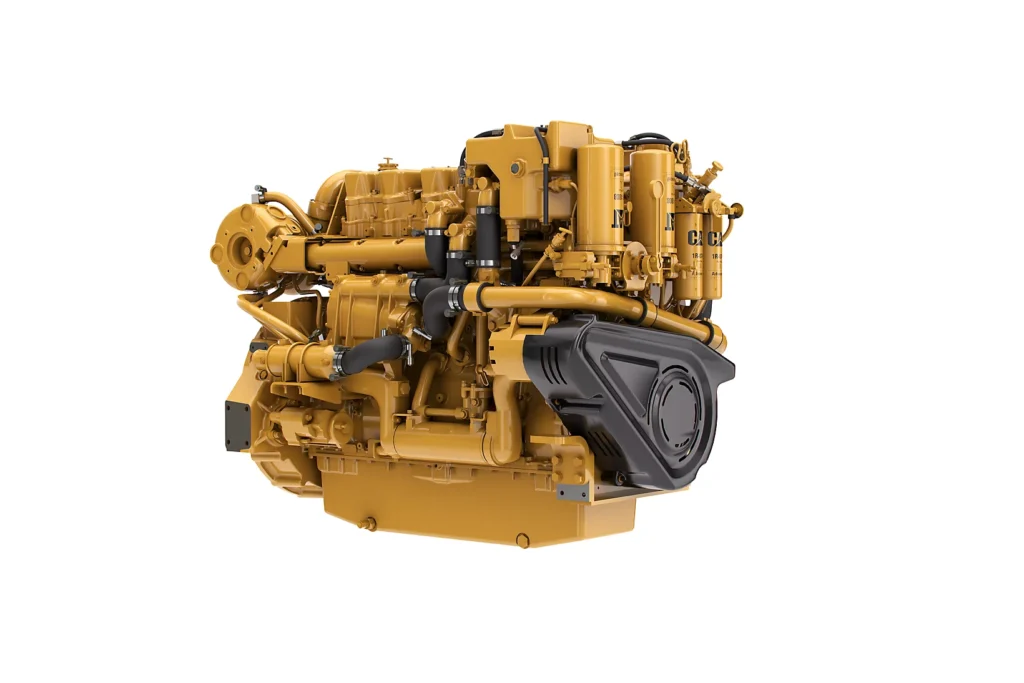
If you’ve been hunting for a Caterpillar C18 marine engine for sale and getting nothing but vague listings and dealers who won’t answer the phone, you’re in the right place. We’re NJ Global Auto Parts, and this is the engine we probably field the most calls about after the C15 — boat owners, fleet operators, and repower shops all asking the same thing: is it real, does it run, and can you get it to me. Short answer: yes, yes, and yes, pretty much anywhere on the planet.
The C18 isn’t a mystery engine. It’s one of the most widely used mid-range marine diesels Caterpillar ever built, and it shows up under the deck of everything from center-console sportfishers to harbor tugs and small ferries. What we’re going to do here is walk through what this engine actually is, what it costs you to own one, what the real specs look like on paper, and what you should be checking before you hand anyone money for a used one — ours included.
We’re writing this from the yard, not a marketing department, so expect some plain talk mixed in with the numbers. Marine engine shopping gets confusing fast once you’re staring down five different C18 rating plates and a dozen sellers all claiming their unit is the good one. Our goal here is to leave you with enough information to ask better questions, whether you end up buying from us or from somebody three states over.
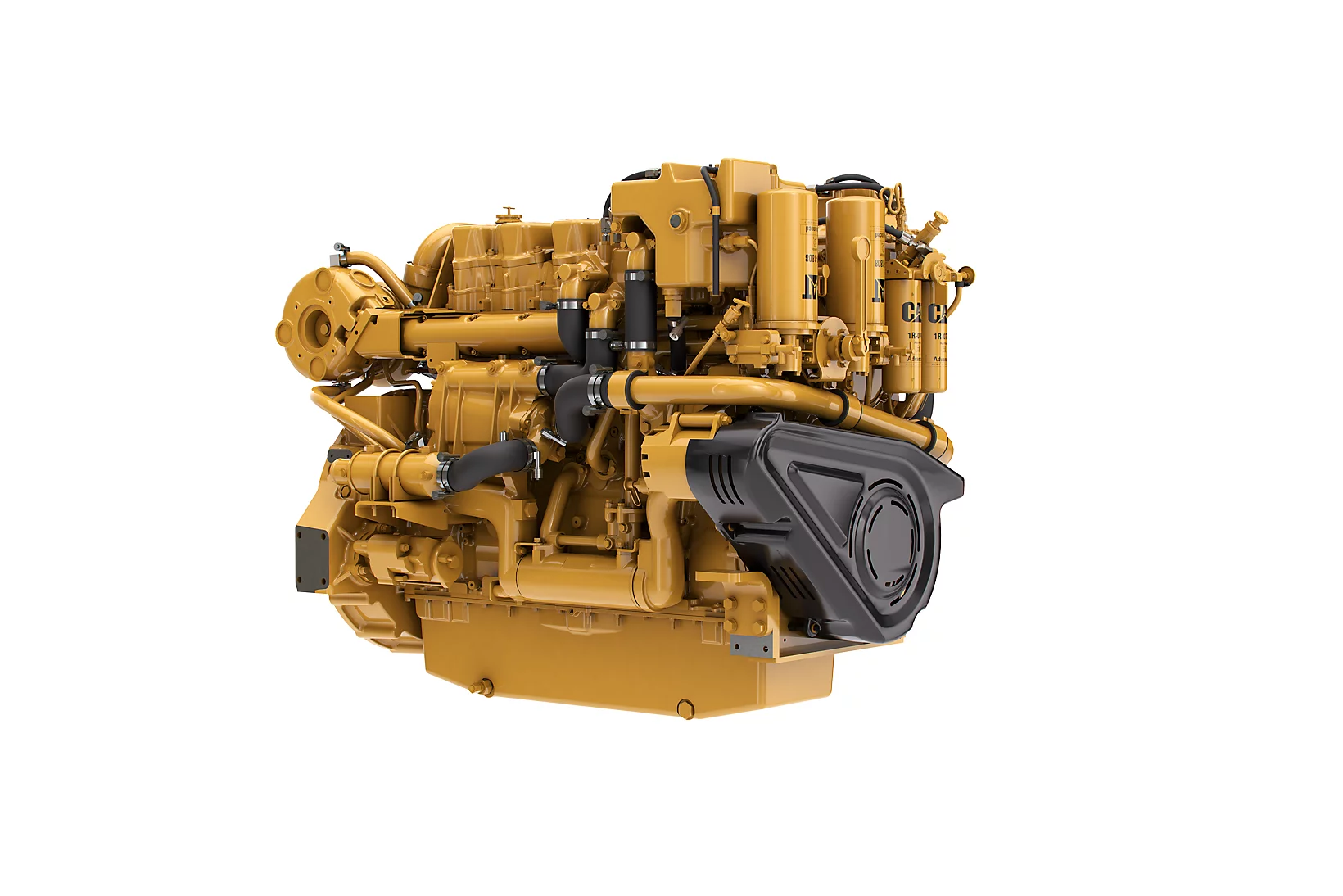
What Makes the Caterpillar C18 Marine Engine Worth a Second Look
There’s a reason this block has stuck around in refit yards and repower shops for so long. The C18 is a 6-cylinder, in-line, turbocharged and aftercooled diesel that Caterpillar built to cover a wide performance window — from a fairly tame 454 bhp commercial rating up past 1,100 bhp in the high-performance pleasure craft versions. That range is unusual. Most manufacturers build a separate block for the low end and the high end. Cat didn’t. Same basic architecture, same bore and stroke, just a different tune, different turbo setup, and different governor calibration depending on what you’re asking it to do.
For a used-engine buyer, that flexibility matters more than it sounds like it should. It means parts commonality across a huge range of applications, mechanics who’ve actually turned a wrench on one before, and a used market that isn’t a graveyard of one-off configurations nobody can source gaskets for anymore. When you’re looking at a Caterpillar C18 marine engine for sale from a reputable seller, you’re not gambling on some orphaned platform — you’re buying into a parts and service network that’s been around for two decades and isn’t going anywhere.
Caterpillar C18 Marine Engine Specifications
Here’s the technical rundown, straight off the block, not marketing copy:
| Configuration | In-line 6-cylinder, 4-stroke diesel |
| Power range | 454 – 1,136 bhp (339 – 847 bkW), depending on rating |
| Rated speed | 1,500 – 2,100 rpm |
| Bore | 5.7 in (145 mm) |
| Stroke | 7.2 in (183 mm) |
| Displacement | 1,106 in³ (18.1 L) |
| Aspiration | Turbocharged, aftercooled (separate circuit aftercooling on most ratings) |
| Dry weight | Approx. 4,000 lb (1,814 kg), varies by rating and accessories |
| Length | Approx. 73 in (1,854 mm) |
| Cooling | Heat exchanger or keel-cooled configurations |
| Emissions | Meets EPA Tier 3 Commercial and IMO II on applicable ratings |
| Flywheel housing | SAE No. 0 or No. 1, depending on application |
A couple of things worth flagging if you’re cross-shopping ratings. The lower-horsepower commercial ratings (think 454–600 bhp) are built for continuous duty — tugs, ferries, workboats that run all day, every day, for years. The higher ratings, up around 1,000+ bhp, are pleasure-craft tuned and expect to spend more time at partial load, cruising, not sitting at max output for twelve hours straight. If someone’s trying to sell you a high-output C18 for full-time commercial duty, ask hard questions about duty cycle, because that’s not what it was built for. You can check Caterpillar’s own numbers on the C18 commercial propulsion engine page if you want to compare rating plates side by side.
The emissions certification is the other thing people skip over and then get burned by later. A C18 built to meet IMO Tier II standards is a different animal internally from an older pre-Tier engine, even if the block casting looks identical. If you’re importing into a region with its own emissions rules, or reselling into one, get the certification level in writing before you buy — not after the engine’s already on a boat. We keep this documented for every commercial-rated unit we sell specifically because we’ve seen buyers get stuck at customs over it.
Why Buy This Caterpillar C18 Marine Engine For Sale Instead of a New One
New marine diesels in this power class aren’t cheap, and the lead times right now aren’t great either — which is exactly why a well-inspected Caterpillar C18 marine engine for sale is worth a serious look. A new C18 repower, with all the marine gear, mounts, and controls, can run well into six figures once you add labor. A tested, low-hour used unit — which is what we stock — gets you into the same power band for a fraction of that, and usually with weeks of lead time instead of months.
That’s not us telling you a used engine is automatically the smarter move for everyone. If you’re repowering a vessel you plan to run for the next twenty years and money genuinely isn’t the constraint, new has its case.
But for most of the operators and owners we talk to — a charter captain replacing a tired mill, a yard doing a repower on a customer’s budget, a fleet manager who needs a spare block on the shelf — a properly inspected used C18 does the job at a price that makes financial sense. We pull compression numbers, check hour meters against service records where we have them, and we don’t list an engine as “ready to run” unless we’ve actually confirmed it will.
Where This Engine Earns Its Keep
This isn’t a boutique engine that only fits one hull design. Because Caterpillar built it across such a wide power band, the C18 ends up in commercial and recreational applications that don’t have much else in common besides needing a dependable mid-range diesel. You’ll find a Caterpillar C18 marine engine for sale doing real work in a lot of places:
- Sportfishing boats and express cruisers in the 45–75 foot range
- Harbor tugs and small workboats running commercial propulsion ratings
- Passenger ferries and crew boats that need continuous-duty reliability
- Government and patrol vessels where downtime isn’t an option
- Yacht repowers where owners want more usable range without a full re-engineering of the engine room
It’s a mid-size engine in Caterpillar’s marine lineup — bigger than the C12, smaller than the 3412 or C32 — which puts it right in the sweet spot for boats that have outgrown a smaller diesel but don’t need (or can’t fit) something in the 32-liter class. Engine room space is almost always the real constraint on a repower, and the C18’s footprint tends to fit where the original engine sat without cutting into the hull.
Cooling setup is worth thinking through before you buy, too. Heat-exchanger cooled units are the more common configuration and work fine as long as raw water quality is decent. Keel-cooled versions show up more on commercial hulls and vessels that spend time in silty or debris-heavy water, since there’s no raw water pump pulling grit through the block. If you’re not sure which configuration your hull needs, that’s a question for your marine surveyor or repower yard before you commit to a specific unit — swapping cooling systems after the fact is not a five-minute job.
Weight matters more on a repower than most people expect going in. At roughly 4,000 lb dry, the C18 is heavy enough that engine mounts, stringers, and even trim can shift slightly once it’s seated. Yards that have done C18 repowers before will tell you this up front. Yards that haven’t sometimes find out the hard way. It’s one more reason we’d rather sell to a shop or owner who’s done their homework, or at least talked to someone who has.
Twin installations are common on larger sportfish and workboat hulls, while single-engine setups show up more on smaller commercial vessels and displacement-hull yachts where redundancy matters less than efficiency. If you’re not sure which configuration fits your hull, that’s worth a conversation with your naval architect or repower yard before you buy anything — the right engine on paper can still be the wrong engine for a specific hull if the shaft angle, weight distribution, or engine room clearance doesn’t line up.
How We Get a Used C18 Ready Before It Ever Gets Listed
We don’t pull an engine off a boat, hose it down, and slap a price tag on it. Every Caterpillar C18 marine engine for sale that comes through our yard goes through a process before it’s listed:
First, we pull the service history if the seller has any — hours, oil analysis reports, injector service dates. If there’s no paper trail, we treat it like a higher-risk unit and price and represent it accordingly. Second, we run a compression and blow-by check on every cylinder, not a sample. Third, we inspect the turbo for shaft play and the aftercooler core for corrosion, since that’s where these engines tend to show their age. Fourth, we check the injectors and fuel system for obvious wear patterns. If something fails at any of these steps, it either gets repaired before listing or it gets sold honestly as a parts or rebuild-candidate unit — not passed off as ready to run.
We also photograph and document the actual unit you’d be buying, not a stock photo standing in for “an engine like this one.” If you’re talking to us about a specific unit, ask for current photos and the inspection sheet before you commit — any seller worth buying from should hand that over without hesitation.
Maintenance, Parts, and What Long-Term Ownership Actually Costs
People ask us less about the purchase price than you’d think, and more about what happens two years down the line. Fair question. A Caterpillar C18 marine engine for sale benefits from a production run long enough that parts availability isn’t a concern the way it would be on some obscure European marine diesel — injectors, turbo cartridges, water pumps, gasket sets, all of it is stocked by Caterpillar dealers and aftermarket suppliers pretty much everywhere. That’s a real cost advantage over the life of the engine, not just at the point of sale.
Routine service intervals run on the shorter side compared to some competing diesels — oil changes around every 250 to 500 hours depending on oil analysis results and how the engine’s being used — but that’s the tradeoff for a design that’s been refined over two decades of real-world duty. Budget for regular oil sampling if you’re running commercial hours. It’s cheap insurance against a bearing or injector problem turning into a rebuild.
On the labor side, most diesel mechanics who work on marine engines have at least some C18 experience, which isn’t true of every platform out there. That matters when your boat is down and you need someone local, not a specialist flown in from three states away. It’s a small thing until you actually need it, and then it’s the only thing that matters.
C18 vs. C15 vs. 3306 — Which Cat Engine Actually Fits Your Boat
We get this question constantly, so it’s worth a straight answer. If you’re cross-shopping the C18 against other Caterpillar diesels we stock, here’s the short version: the Caterpillar C15 is the more common on-highway-derived block, cheaper to source and rebuild, and a great fit if you don’t need the C18’s higher-end power ratings. We’ve also written up how reliable the C15 actually is in the real world, and a fuel consumption breakdown if efficiency is what’s driving your decision. If you’re working on an older vessel or industrial application, the Caterpillar 3306 is the older, simpler mechanical platform — less power, but about as basic and field-serviceable as a diesel gets.
As a Caterpillar C18 marine engine for sale, it sits above both of those in terms of power density and modern electronic controls. If your boat needs more shaft horsepower than a C15 comfortably delivers, or you want the continuous-duty commercial ratings the 3306 was never built for, the C18 is usually the right call. We can walk you through the actual numbers for your hull and application if you call or email — that’s a five-minute conversation that saves people from buying the wrong engine more often than you’d think.
Shipping Your Caterpillar C18 Marine Engine Anywhere in the World
Every Caterpillar C18 marine engine for sale we ship goes out internationally as a matter of routine, not as a special arrangement. Engines get crated on marine-rated pallets, drained and prepped per freight-forwarder requirements, and documented with the paperwork customs brokers actually need — commercial invoice, packing list, HS codes, the works. We’ve sent engines to ports across North America, Europe, the Middle East, Southeast Asia, and Australia, and the freight side is honestly one of the more boring parts of the process because we’ve done it enough times to have it down to a routine.
If you’re buying from outside the U.S., ask us for a freight quote to your port before you finalize anything — ocean freight for something this size is a real cost, and it’s better to know that number up front than to be surprised by it after the engine’s already crated. We work with freight forwarders in most major markets and can usually get you a landed-cost estimate within a day.
What to Check Before You Buy a Used Marine Diesel
Whether you buy from us or somewhere else, a few things are worth checking on any Caterpillar C18 marine engine for sale before money changes hands:
- Ask for actual hour-meter photos, not just a quoted number
- Get compression numbers for every cylinder, not an average
- Check for salt water intrusion history if it’s a raw-water-cooled unit that’s seen coastal use
- Confirm which rating it is — commercial or high-performance — since that changes what it’s rated to do long-term
- Ask whether the injectors and turbo have been serviced, and when
Any seller who gets cagey about answering these is telling you something, even if they never say it outright. We’d rather lose a sale to someone asking hard questions than have a customer find out three weeks after delivery that the engine wasn’t what they thought.
Pricing, Warranty, and How to Get This Engine on a Truck
Pricing on a Caterpillar C18 marine engine for sale depends heavily on the rating, hours, and condition of the specific unit — there’s no single number that’s honest across the board, which is why we don’t post a flat price and call it a day. What we can tell you is that every engine we sell comes with a warranty period on major components, a written inspection summary, and a real phone number if something comes up after delivery. That’s the whole pitch, really: we sell engines the way we’d want to buy one.
If you’re ready to move forward, reach out through our used diesel engine listings or give us a call with your hull, application, and timeline, and we’ll tell you straight whether the C18 we’ve got in stock is the right fit — or whether you’d honestly be better off with a rebuilt unit instead of a used one. We’d rather talk you into the right engine than talk you into any engine.
Frequently Asked Questions
How much horsepower does a Caterpillar C18 marine engine make?
Depending on the rating, a Caterpillar C18 marine engine runs anywhere from about 454 bhp on the continuous-duty commercial ratings up to roughly 1,136 bhp on the high-performance pleasure craft calibrations. The exact number on any Caterpillar C18 marine engine for sale should be confirmed against its rating plate, not assumed from a spec sheet.
Is the Caterpillar C18 a good engine for a sportfishing boat?
Yes, for most hulls in the 45 to 75 foot range. The higher-output ratings were built with exactly this kind of application in mind, and the power-to-weight numbers work well for planing and semi-displacement sportfish hulls that need to get up on plane and hold cruise speed without straining.
Do you ship a Caterpillar C18 marine engine for sale outside the United States?
Yes. We crate and ship internationally as routine business, not a special request, and we’ve sent these engines to buyers across North America, Europe, the Middle East, Asia-Pacific, and beyond. Freight, documentation, and customs paperwork are handled as part of the sale — ask for a landed-cost quote to your port before you commit.
What’s the difference between a commercial-rated and high-performance C18?
The commercial ratings are tuned for continuous, full-load duty — tugs, ferries, workboats. The high-performance ratings are tuned for pleasure craft that spend more time cruising below max output. They share the same basic block, but the turbo calibration, governor settings, and duty-cycle expectations are different, so matching the right rating to your application matters more than chasing the highest horsepower number.
Should I buy a used C18 or pay for a full rebuild?
It depends on hours, condition, and budget, the same factors that should guide any Caterpillar C18 marine engine for sale purchase. A well-inspected used engine with documented history is often the better value if you need the boat running soon. A rebuild makes more sense if you’re planning to keep the vessel long-term and want a known-zero-hour engine. We’re happy to talk through both options honestly rather than just pushing whichever one we happen to have in stock.
A Caterpillar C18 marine engine for sale isn’t hard to find. Finding one that’s been honestly inspected, priced fairly, and backed by someone who’ll pick up the phone in six months — that’s the part worth paying attention to. That’s what we’re set up to do, wherever in the world you’re calling from.