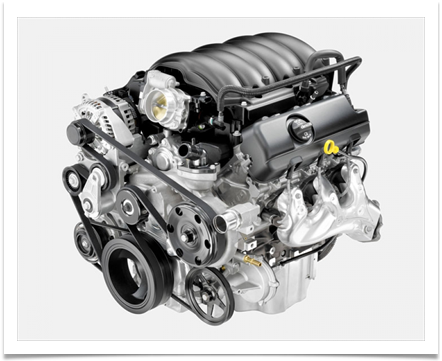
The 6G74 is the 3.5 litre V6 that Mitsubishi put in the Pajero, the Montero, the Challenger and a handful of other cars from the 1990s into the 2000s. It is an old school engine with an iron block and a timing belt, and in most of its versions it is simple and tough. Plenty have gone past 300,000 km. But they are old now, and old engines have habits. If you are searching for Mitsubishi 6G74 engine problems, you probably have smoke on start up, a tick from the top end, an oil leak, or a Pajero that runs rough.
We are NJ Global Auto Parts, and we sell replacement engines worldwide. The 6G74 is a regular for us. Pajero and Montero owners, Challenger and Pajero Sport owners, and workshops all over the world come to us when their engine is beyond saving. We see what comes out of these vehicles, so this guide to Mitsubishi 6G74 engine problems comes from real engines, not a parts catalogue.
Need an engine now? See our Mitsubishi 6G74 engine for sale page or send your VIN through the contact page.
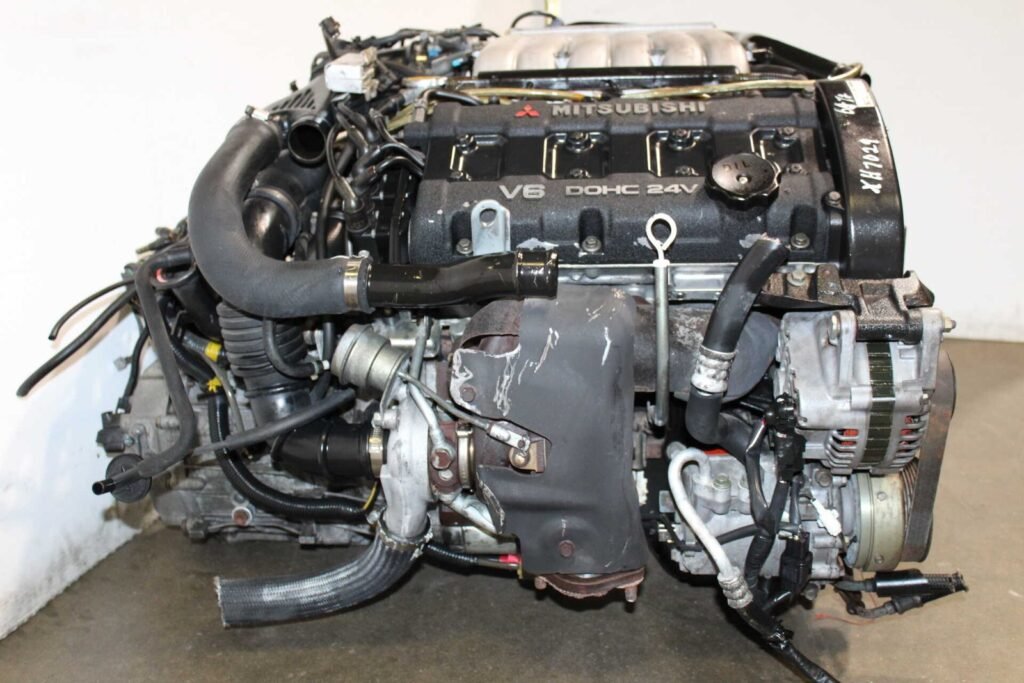
Mitsubishi 6G74 Engine Problems: What You Need to Know First
The core of the 6G74 is strong. Iron block, forged crank in many versions, and a fairly gentle state of tune in most vehicles. Most Mitsubishi 6G74 engine problems come from age and maintenance: worn valve stem seals that burn oil, noisy hydraulic lifters, oil leaks, overdue timing belts, and cooling system wear.
The GDI version is different. Direct injection made it more efficient, but it added parts that do not like poor fuel and neglect. If you have a GDI 6G74, some of the problems below apply to you more than to the regular port injected engines.
Mitsubishi 6G74 Specifications
| Specification | Mitsubishi 6G74 |
|---|---|
| Layout | 60 degree V6, naturally aspirated |
| Displacement | 3,497 cc (3.5 L) |
| Bore x stroke | 93.0 mm x 85.8 mm |
| Valve train | SOHC 24 valve on most, DOHC 24 valve on some versions |
| Variable valve timing | MIVEC on some DOHC versions |
| Timing drive | Timing belt |
| Block | Cast iron |
| Heads | Aluminium |
| Fuel system | Multi point injection, or GDI direct injection on some versions |
| Power, common SOHC versions | About 200 to 208 hp (147 to 153 kW) |
| Torque, common SOHC versions | About 300 to 320 Nm |
| Power, GDI versions | About 200 hp, with torque up to about 343 Nm |
| Power, DOHC MIVEC performance versions | Up to about 280 PS |
The SOHC engine in the Pajero is the one most people know. It is not powerful by modern standards, but it pulls well from low revs, which suits a heavy 4×4. Knowing which version you have matters, because Mitsubishi 6G74 engine problems differ a bit between the port injected SOHC, the GDI and the DOHC engines.
Vehicles With the 6G74
- Mitsubishi Pajero and Montero, second generation V20 series
- Mitsubishi Pajero and Montero, third generation V60 and V70 series (NM, NP)
- Mitsubishi Challenger, Montero Sport and Pajero Sport
- Mitsubishi Pajero Evolution, DOHC MIVEC version
- Mitsubishi Diamante, Magna and Verada in some markets
- Mitsubishi Triton and L200 V6 in some markets
- Mitsubishi Debonair
Engines from different vehicles have different sumps, intakes, wiring and mounts, and front wheel drive cars mount the engine sideways. Always match by engine number and vehicle when replacing one after Mitsubishi 6G74 engine problems.
Problem 1: Valve Stem Seals and Blue Smoke
This is the classic. You start the engine after it has sat overnight, and a puff of blue smoke comes out of the exhaust. It clears after a few seconds. That is oil that leaked past hardened valve stem seals and sat on top of the valves while the engine was off.
It is common on older 6G7 family engines. It is annoying, it uses some oil, and it can foul plugs, but on its own it does not destroy the engine. Replacing the seals fixes it. It can be done with the heads on, using air pressure to hold the valves up, though many mechanics prefer to do it with the heads off. Out of all Mitsubishi 6G74 engine problems, this is the one owners notice first.
If the smoke continues while driving, not just at start up, it may be rings or the PCV system instead. A compression test tells you which, and stops you paying to fix the wrong one of your Mitsubishi 6G74 engine problems.
Problem 2: Ticking Hydraulic Lifters
The 6G74 uses hydraulic lash adjusters to keep valve clearance right. When they wear, get dirty oil in them, or lose oil pressure, they tick. The tick is loudest on cold start and may fade as the engine warms. Some engines tick all the time.
Often a good oil change with the right grade quietens them. If not, the noisy adjusters need replacing. It is one of the cheaper Mitsubishi 6G74 engine problems to sort. A tick that gets louder over time and does not change with oil is worth checking, because it could be something more serious, like a worn rocker or a cam lobe. Ticking lifters are one of the noisiest Mitsubishi 6G74 engine problems, but usually not the most dangerous.
Problem 3: Timing Belt Neglect
The 6G74 uses a timing belt, not a chain. Belts have a service interval, usually somewhere around 90,000 to 100,000 km or a set number of years, whichever comes first. Check your service book for the exact figure. On old vehicles with patchy history, nobody knows when it was last done.
When a belt snaps, the engine stops instantly. Depending on the version, it can also bend valves. Treat it as if it can. Do the belt, tensioner, idler and water pump together, since the water pump is driven by the belt and the labour overlaps. A snapped belt on a vehicle with unknown history is one of the Mitsubishi 6G74 engine problems that most often sends people looking for a replacement engine.
Problem 4: Oil Leaks
Older 6G74 engines leak oil. Common spots are the valve cover gaskets, the spark plug tube seals, the front crank and cam seals, the oil pump seal, the sump gasket and the rear main seal. Small leaks are mostly a nuisance and the most common of all Mitsubishi 6G74 engine problems on older vehicles. Big ones drop oil on the exhaust and make the engine run low.
Front seals are best replaced when the timing belt is done, because the belt has to come off anyway. A leaking front seal that soaks the new belt in oil will shorten its life. That is how one of the small Mitsubishi 6G74 engine problems leads to a big one.
Problem 5: GDI Fuel System Faults
The GDI 6G74, mainly found in the third generation Pajero and Montero in some markets, uses a high pressure fuel pump and direct injectors. These parts are sensitive to poor fuel and water in fuel. Owners report rough running, hard starting, misfires and fault codes when the pump or injectors start to fail.
Carbon build up on the intake valves is another GDI habit. With fuel no longer washing the valves, deposits build up and restrict airflow. The EGR system adds soot to the mix. Rough idle and stalling can follow. In markets with inconsistent fuel quality, the GDI is responsible for a large share of Mitsubishi 6G74 engine problems we hear about.
Problem 6: Cooling System Wear and Overheating
Radiators clog, water pumps leak, thermostats stick and hoses go hard. On a heavy 4×4 working in heat, towing or crawling off road, the cooling system is under real load. Overheating an iron block with aluminium heads can warp the heads and blow head gaskets.
Watch the temperature gauge, keep the radiator clean, and replace the water pump with the timing belt. Overheating damage is among the more expensive Mitsubishi 6G74 engine problems because it can mean head work or a replacement engine.
Problem 7: Idle, Sensors and Ignition
- Idle speed control faults causing unstable idle or stalling.
- Throttle body deposits causing poor idle.
- Knock sensor faults and wiring problems.
- Coil packs and leads causing misfires as they age.
- Oxygen sensors causing poor fuel economy.
- Crank pulley wear and wobble.
These are the everyday Mitsubishi 6G74 engine problems. None is serious alone, but on an old vehicle they tend to come in groups.
Warning Signs to Watch For
- Blue smoke on start up
- Ticking from the top of the engine
- Oil spots under the vehicle
- Temperature gauge climbing when towing or in traffic
- Rough idle or stalling
- Check engine light with misfire codes
- A whine or squeal from the timing belt area
- Unknown timing belt history
Write down when each sign started. It helps the mechanic, and it helps you tell whether Mitsubishi 6G74 engine problems are getting worse or staying put.
SOHC, DOHC or GDI: Which Is Most Reliable?
In our experience, the plain SOHC port injected 6G74 is the toughest and simplest to keep. It has the fewest complex parts and the most mechanics who know it. The DOHC MIVEC engines are more performance focused and less common. The GDI engine is fine with good fuel and care, but it is the most sensitive of the three.
If you have a choice when buying a vehicle or a replacement engine, the SOHC port injected version is the safe pick. Many Mitsubishi 6G74 engine problems are simply easier to live with on that version.
Can You Swap a GDI for a Non GDI Engine?
Some owners in regions with poor fuel want to replace a GDI 6G74 with a port injected one. It can be done, but it is not a straight swap. The engine computer, wiring, fuel system and some sensors differ, and emissions rules may apply. If you are considering it, talk to a workshop that has done one before, and talk to us about which engine and parts you would need. We would rather help you plan it properly than sell you half a solution to your Mitsubishi 6G74 engine problems.
A Case We See Often
Here is a story we hear in some form every month. Someone buys an older Pajero with a 6G74. It smokes a little on start up and ticks when cold, but it drives fine, so they leave it. Nobody knows when the timing belt was last changed. A year later the belt lets go on the highway. The engine stops, and when the mechanic checks, some valves are bent.
By then the head needs work, the belt kit needs doing, and the seals and lifters still need attention. On an engine with high mileage, that adds up to more than a good used 6G74. That is the point where they call us. The irony is that the belt itself was a modest cost. Most serious Mitsubishi 6G74 engine problems start with a cheap job put off for too long.
Off Road and Towing
The 6G74 lives in 4x4s, and many of them work hard. Off road driving means low speed, high load and little cooling air. Towing means long climbs with the engine under strain. Both raise oil and coolant temperatures and push the cooling system to its limit.
If your Pajero or Montero works like that, keep the radiator fins clean, check the fan clutch, use a good coolant mix and change the oil more often. Fit a transmission cooler if you tow heavy loads. Heat is behind a lot of the bigger Mitsubishi 6G74 engine problems, and hard working 4x4s see more heat than most.
Buying a Used Pajero or Montero With a 6G74
These vehicles are still popular and still good value. Before you buy one, check these:
- Ask for proof of the last timing belt change. If there is none, budget for one straight away.
- Start it from cold yourself and watch the exhaust for blue smoke.
- Listen for lifter tick and any knock from low down.
- Look underneath for oil leaks, especially at the front of the engine.
- Check the coolant for oil and the oil for coolant.
- Scan for fault codes, particularly on GDI versions.
A vehicle that passes these checks has avoided the worst Mitsubishi 6G74 engine problems so far. One that fails can still be a fair buy if the price allows for repairs or a replacement engine. We can quote an engine before you commit.
What Repairs Cost, Relatively
| Job | Relative cost |
|---|---|
| Spark plugs and leads | Low |
| Valve cover and plug tube seals | Low |
| Hydraulic lifters | Low to medium |
| Valve stem seals | Medium |
| Timing belt, tensioner, idler and water pump | Medium |
| GDI high pressure pump | Medium to high |
| Head repair after belt failure | High |
| Replacement engine | Medium to high, fixed and known |
The pattern is clear. The everyday Mitsubishi 6G74 engine problems are cheap. The expensive ones come from skipping the cheap ones.
Shipping and Fitting a Replacement 6G74
We crate 6G74 engines on pallets, seal all the openings, and ship by sea or air with tracking. When it arrives, have your mechanic check it against the photos and engine number, move over any parts that the replacement does not include, and fit new gaskets and fresh fluids. Because timing belt history on a used engine is not always known, we strongly suggest fitting a new belt kit and water pump while the engine is out. It is far easier then, and it means your new engine starts life without the most dangerous of the Mitsubishi 6G74 engine problems hanging over it.
How Serious Are Mitsubishi 6G74 Engine Problems?
| Fault | How common | Risk if ignored |
|---|---|---|
| Valve stem seals | Very common | Low to medium |
| Ticking lifters | Common | Low |
| Timing belt overdue | Common on old vehicles | Very high |
| Oil leaks | Very common | Low to medium |
| GDI pump and injectors | GDI engines | Medium |
| Overheating | Hard working vehicles | High |
| Idle and sensor faults | Common | Low |
Repair or Replace?
Most Mitsubishi 6G74 engine problems are repairs, not reasons to give up on the engine. Seals, lifters, gaskets, belts and sensors are all fixable, and parts are easy to find. A replacement engine makes sense when:
- The timing belt snapped and bent valves on a high mileage engine
- The engine overheated and warped the heads or cracked something
- There is a knock from the bottom end
- Compression is low and uneven across several cylinders
- The engine has very high mileage and several big faults at once
Get a written repair quote, then ask us for a delivered engine price. Compare honestly, including how long the vehicle will be off the road. For older Pajeros, a good used 6G74 often costs less than fixing a worn out one.
Buying a Replacement 6G74: What to Check
- Engine number and version. SOHC, DOHC or GDI, and the vehicle it suits.
- Donor vehicle and mileage.
- Timing belt history. Plan to replace it on fitting if unknown.
- Compression test on all six cylinders.
- Smoke on start up. Ask, or check on a video run.
- Oil condition. No milky colour, no metal.
- Warranty in writing.
We send the engine number, photos and test details with each quote. If you are replacing an engine because of Mitsubishi 6G74 engine problems, you should know what you are getting this time.
How to Keep a 6G74 Going
- Change oil regularly with the right grade. Lifters love clean oil.
- Replace the timing belt, tensioner, idler and water pump on schedule.
- Fix oil leaks before they reach the belt.
- Keep the cooling system clean and full.
- Use good fuel, especially in a GDI engine.
- Replace plugs and leads on time.
- Do not ignore a rising temperature gauge.
Do these and most Mitsubishi 6G74 engine problems stay minor.
Why Buy From NJ Global Auto Parts
- Used 6G74 engines from Pajero, Montero, Challenger and other donors
- SOHC, DOHC and GDI versions matched to your vehicle
- Complete engines and long blocks
- Photos and test details before purchase
- Worldwide shipping, crated and tracked
- Written warranty
More reading: our 6G74 buying checklist and the guide to buying a 6G74 engine online.
Other Mitsubishi Engines We Supply
- Mitsubishi 4D56 turbo diesel
- Mitsubishi 4M40, the Pajero diesel
- Mitsubishi 4M50
- Mitsubishi 4M51
- Mitsubishi 4B11T
- Nissan VQ40DE V6 for other 4×4 owners
See all Mitsubishi engines or our shop.
How to Order
- Send your VIN, engine number and delivery country.
- We confirm the version and send details and photos.
- You get a written quote with engine, warranty and shipping.
- Once confirmed, we crate and ship with tracking.
Start on our contact page.
About Our Warranty and Support
Every engine we sell comes with a written warranty. The terms depend on the engine and whether it is used or rebuilt, and we put them in writing before you pay, not after. Most warranties ask for fitting by a qualified mechanic, fresh oil and coolant, new filters, and a record of the work. Keep your receipts. If something goes wrong, they make the claim simple.
We also stay on the line after the sale. If your mechanic has a question during fitting, about a sensor, a bracket, or a part that looks different from the old engine, send us a message with a photo and we will help. Plenty of customers come back to us for their second and third engines because of that. When you are dealing with Mitsubishi 6G74 engine problems, it helps to have a supplier who answers the phone.
Mitsubishi 6G74 Engine Problems FAQ
Is the 6G74 a reliable engine?
Yes, especially the SOHC port injected version. Most Mitsubishi 6G74 engine problems are age related: seals, lifters, leaks and belts.
Why does my Pajero smoke blue on start up?
Usually worn valve stem seals. Oil seeps past them overnight and burns off when you start.
Does the 6G74 have a timing belt or chain?
A timing belt. Replace it on schedule along with the tensioner, idler and water pump.
How long does a 6G74 last?
With good care, many pass 300,000 km. History matters more than the number on the dash.
Is the GDI version worth avoiding?
Not if you have good fuel and keep up maintenance. In areas with poor fuel, the port injected version is the easier engine to own.
Do you ship worldwide?
Yes.
Sort Out Mitsubishi 6G74 Engine Problems Before They Get Expensive
The 6G74 is a tough old V6. Keep the belt fresh, the oil clean, the cooling system healthy, and most Mitsubishi 6G74 engine problems stay small. If your engine is past saving, a checked replacement from us gets your Pajero or Montero back on the road.
Send your details on the contact page, browse our used engines, or read more on the blog. For background, see the Mitsubishi 6G7 engine family and this explainer on timing belts.