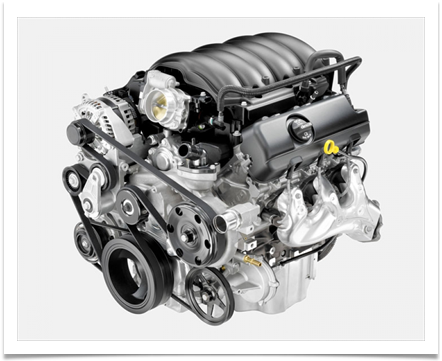
If you are looking for new tires for sale, you probably have a car, SUV or truck that is running on worn tread, a tire that keeps losing air, or a set that cracked from sitting in the sun. Maybe you run a fleet or a tire shop and need stock. Either way, this page is for you.
We are NJ Global Auto Parts. Most people know us for engines, but we also sell new tires for cars, SUVs, 4x4s, vans and trucks, and we ship them all over the world, from a single set of four to full container loads. This guide covers what we tell buyers every day: how to read a tire size, which type to choose, what the load and speed numbers mean, what to check before you pay, and how shipping works.
If you already know your size, go straight to our new tires product page and ask for a price.
Why Buy New Tires for Sale Instead of Used
Used tires have their place. If money is very tight, a good used set can get you through. We even sell them. But for most drivers, new tires for sale are the better deal over time.
- Full tread depth. A new tire starts with roughly 8 to 9 mm of tread on a car tire, more on 4×4 and truck tires. A used one might have half that.
- Known age. Rubber ages even when it is not used. With new tires you know they were made recently.
- No hidden repairs. Used tires can have plugs, patches or sidewall damage you cannot see.
- Better grip and braking, especially in the wet.
- Longer life, so the cost per kilometre is often lower.
If you still want to compare, our guide to used car tires for sale explains when used makes sense.
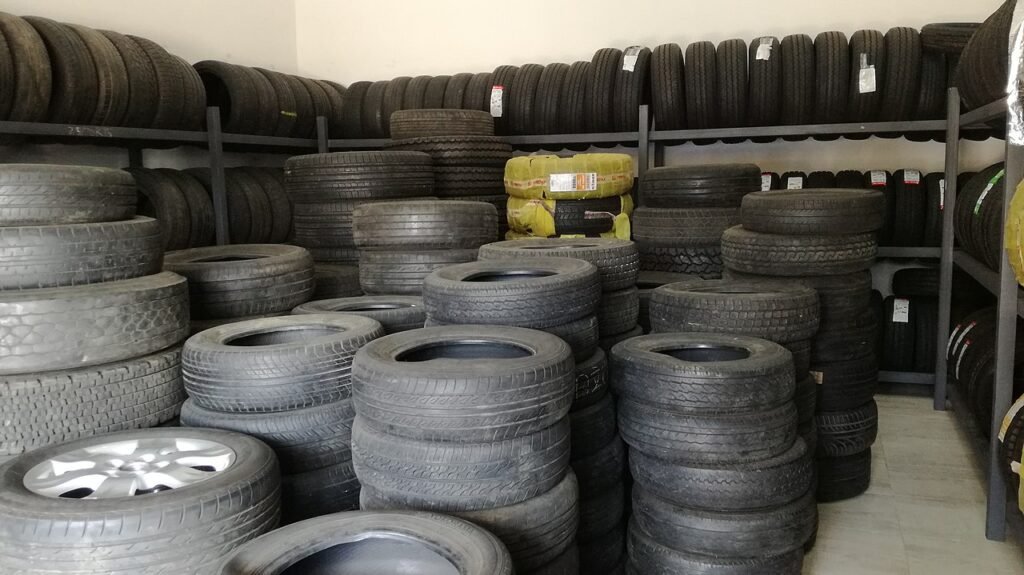
New Tires for Sale: How to Read the Size
Before you order any new tires for sale, you need the size. It is printed on the sidewall of your current tires and on a sticker inside the driver’s door or fuel flap. A typical size looks like this:
225/65R17 102H
| 225 | Tire width in millimetres |
| 65 | Aspect ratio. The sidewall height is 65% of the width |
| R | Radial construction |
| 17 | Rim diameter in inches |
| 102 | Load index (how much weight each tire can carry) |
| H | Speed rating (maximum safe speed) |
Truck and 4×4 tires sometimes use a different system, like LT265/75R16 or 31×10.50R15. LT means light truck construction, which is tougher and carries more load. Commercial truck tires use sizes like 295/80R22.5 or 11R22.5.
The tire code page has a full breakdown of every marking if you want to go deeper.
New Tires for Sale: Load Index and Speed Rating Specs
These two numbers matter more than most people think. Never fit a tire with a lower load index or speed rating than your vehicle maker specifies.
Common load index values
| 91 | 615 kg per tire |
| 95 | 690 kg per tire |
| 100 | 800 kg per tire |
| 104 | 900 kg per tire |
| 110 | 1,060 kg per tire |
| 116 | 1,250 kg per tire |
| 121 | 1,450 kg per tire |
Common speed ratings
| Q | 160 km/h |
| S | 180 km/h |
| T | 190 km/h |
| H | 210 km/h |
| V | 240 km/h |
| W | 270 km/h |
| Y | 300 km/h |
When you ask us for new tires for sale, give us the full size including these two codes. We will match them or go higher, never lower.
Types of New Tires for Sale We Supply
There is no single best tire. The right one depends on where you live, what you drive and how you use it. These are the main types of new tires for sale we stock.
All-season tires
The everyday choice for most cars and SUVs. Decent grip in dry and wet weather, long tread life, quiet on the road. Fine for mild winters but not for heavy snow and ice.
Summer and performance tires
Softer rubber and more grip in warm weather. Great for sporty cars and hot climates. They wear faster and should not be used in freezing temperatures.
Winter tires
Made for snow, ice and cold. The rubber stays soft below about 7 degrees Celsius, and the tread has lots of small cuts called sipes that grip on ice. See our winter tires page.
All-terrain tires
For 4x4s and pickups that spend time on gravel, dirt and the road. A good middle ground. Check our 4×4 tires.
Mud-terrain tires
Big open tread blocks for mud, rocks and serious off-road use. Louder on the road and they wear faster on tarmac.
Highway and light truck tires
Built for vans, pickups and SUVs that carry weight. Strong sidewalls and higher load ratings.
Commercial truck and bus tires
Steer, drive and trailer tires for heavy vehicles. Our truck tires page and the guide to truck tires for sale go into more detail.
Agricultural tires
For tractors and farm equipment. See our tractor tires and the tractor tires guide.
Tread Patterns Explained in Plain Words
When you look through new tires for sale, you will see three main tread designs. They are not just for looks.
Symmetrical. The same pattern across the whole tread. Quiet, long lasting and cheap. You can rotate them any way you like. Common on everyday cars.
Asymmetrical. The inner and outer halves are different. The outside is built for cornering grip, the inside for water clearance. These have an “outside” marking on the sidewall, and the tire shop must fit them the right way round.
Directional. A V-shaped pattern that is designed to roll one way only. Very good at clearing water and slush. There is an arrow on the sidewall showing the rolling direction. They can only be rotated front to back on the same side.
None of these is better for everyone. If your car came with a certain type, sticking with it is a safe choice.
XL, Run-Flat and Other Sidewall Markings
A few more markings come up when people order new tires for sale from us:
- XL or Reinforced. Extra load tires. They carry more weight at a higher pressure. Many SUVs and some cars need them.
- RFT, ROF, ZP or SSR. Run-flat tires. They let you keep driving a short distance after a puncture. If your car came with run-flats and has no spare, keep using them.
- M+S. Mud and snow. Shows the tire has some ability in light snow and mud. Not the same as a true winter tire.
- 3PMSF. The three-peak mountain snowflake symbol. This tire passed a proper snow test.
- TWI. Points to where the tread wear indicators are.
- Treadwear, traction and temperature grades. Found on many tires. A higher treadwear number usually means longer life.
If you are not sure what your vehicle needs, send us a photo of your current tire sidewall and we will read it for you.
How to Choose the Right New Tires for Sale for Your Vehicle
Here is the simple way we help customers pick new tires for sale without overthinking it.
- Start with the size on the door sticker. That is what the vehicle was designed for.
- Think about your weather. Hot all year, go all-season or summer. Snow and ice, get winter tires or at least good all-season tires with the snowflake symbol.
- Think about your roads. Mostly tarmac, go highway or all-season. Gravel and dirt, look at all-terrain.
- Think about load. If you carry heavy loads or tow, choose LT or a higher load index.
- Set a budget. Premium brands last longer and grip better. Mid-range brands are often the best value. Budget brands are fine for light use.
- Buy in sets. Four matching tires is best. At minimum, match tires on the same axle.
If you are stuck, tell us your vehicle, where you drive and what you carry. We will suggest two or three options at different prices.
Matching Tires to Your Climate and Roads
Because we ship worldwide, we see buyers in very different conditions, and the right new tires for sale change a lot from one place to another.
Hot, dry regions. Heat is hard on rubber. Choose tires with a good heat rating, keep the pressure right, and avoid cheap tires that crack early in the sun.
Tropical and rainy regions. Wet grip matters most. Look for deep grooves and good water clearance. Replace tires before the tread gets low.
Cold and snowy regions. Winter tires with the snowflake symbol make a huge difference in braking and steering.
Rough or unpaved roads. All-terrain or LT tires with stronger sidewalls hold up much better against stones and potholes.
Mostly highway driving. A quiet, long-lasting all-season or highway tire saves fuel and money.
Tell us where and how you drive, and we will point you to the right type.
Brands We Supply
Our new tires for sale come from well-known international brands and solid mid-range makers. Availability changes with stock, but we regularly supply tires from brands such as Michelin, Bridgestone, Continental, Goodyear, Pirelli, Dunlop, Yokohama, Toyo, Hankook, Kumho, BFGoodrich and several good value brands.
Brand matters, but the right type and size matter more. A mid-range all-terrain on a 4×4 will beat a premium summer tire on the same truck every time.
What We Check on Every Batch of New Tires for Sale
New does not always mean perfect. Tires can be old stock, stored badly, or damaged in transport. Here is what we check on new tires for sale before they leave.
1. Manufacture date
Every tire has a DOT code on the sidewall. The last four digits are the week and year it was made. For example, 2326 means week 23 of 2026. We do not sell old stock as new.
2. Storage condition
Tires should be stored cool, dry and out of the sun. We check for cracking, flat spots and discolouration.
3. Matching sets
Sets should match in size, model and close in date.
4. Labels and markings
We check the size, load index and speed rating against your order.
5. Packing
Tires are packed so they do not get crushed, cut or stained in transit.
6. Photos on request
For larger orders, we send photos of the actual stock and the DOT codes.
7. Written order list
Every order comes with a list of sizes, brands, models and quantities so you can check it on arrival.
New Tires for Sale Prices: What Affects the Cost
The price of new tires for sale depends on a few things:
- Size. Bigger rims and wider tires cost more.
- Type. Winter, performance and mud-terrain tires usually cost more than basic all-season tires.
- Brand. Premium brands cost more than mid-range and budget ones.
- Load and speed rating. Higher ratings often cost more.
- Quantity. Larger orders get better prices. Container loads get the best.
- Shipping. Tires are bulky. Sea freight is far cheaper than air.
Watch out for prices that look too good. Very cheap new tires for sale are sometimes old stock or poor quality. Ask for the DOT date and the exact brand and model.
Wholesale and Bulk New Tires for Sale
A big part of our tire business is supplying shops, fleets and resellers. If you need new tires for sale in volume, we can help with:
- Mixed container loads in different sizes and brands.
- Fleet orders for vans, pickups and trucks.
- Regular orders on a schedule.
- Matching engines and parts in the same shipment, if you also need them.
That last point saves a lot of money for workshops. Popular engines that ship with tire orders include the Toyota 2AR, the Nissan QD32T diesel and the Chrysler Hemi V8. Many of our customers order an engine and a set of tires in one shipment. You can browse our engines and the tires and wheels category to plan an order.
Worldwide Shipping on New Tires for Sale
We ship tires to buyers all over the world. For one set, air freight or courier can work, but it is expensive because tires are bulky. For larger orders, sea freight in a container is the way to go.
Here is how shipping new tires for sale works with us:
- We confirm sizes, brands and quantities.
- Tires are packed or stacked to protect them.
- We send tracking and shipping documents.
- You or your agent clear them through customs.
Some countries have specific rules for importing tires, and duties vary. Check with your local customs office or a clearing agent first. The World Customs Organization has general information on customs. Our shipping policy explains packing and delivery.
How to Order New Tires for Sale From Us
- Send your sizes. Full size with load index and speed rating, the vehicle and how many you need. Use the contact form or chat.
- Get a quote. Brand options, prices and the shipping cost.
- Confirm. We send photos for bigger orders.
- Pay. See our billing terms.
- We ship. You get tracking.
If something is wrong when your order arrives, contact us with photos straight away. Our refund and returns policy explains the process.
Fitting Your New Tires the Right Way
Good tires fitted badly are a waste of money. Here is what we tell every buyer:
- Use a proper tire shop with a balancing machine.
- Balance every wheel. An unbalanced wheel causes vibration and uneven wear.
- Fit new valves. They are cheap and old ones crack.
- Check the wheel alignment. Bad alignment eats new tires fast.
- Put the best tires on the rear if you only replace two. It helps stability in the wet.
- Set the pressure to the number on the door sticker, not the maximum on the tire.
- Torque the wheel nuts properly and check them again after 50 to 100 km.
The NHTSA tire safety page has helpful general advice on pressure, tread and tire age.
How to Store Tires Before Fitting
Some customers buy new tires for sale ahead of time, for winter changeovers or for stock. Store them well and they will be as good on the day you fit them as the day they arrived.
- Keep them indoors, cool and dry.
- Keep them out of direct sunlight. UV light dries out the rubber.
- Keep them away from electric motors, welders and heaters, which give off ozone and heat.
- Stand tires without rims upright and turn them now and then. Tires on rims can be stacked or hung.
- Keep them away from fuel, oil and solvents.
- Use tire bags if you have them, especially for long storage.
For shops holding stock, rotate it first in, first out so the oldest tires sell first.
Getting Tire Pressure Right
Pressure is the simplest thing to get right and the one most people get wrong. Too low and the tire flexes, heats up, wears on the edges and uses more fuel. Too high and it wears in the centre, grips less and rides hard.
Use the pressure on the sticker inside the driver’s door or fuel flap. Check it when the tires are cold, before driving or after the vehicle has been parked for a few hours. Add pressure if you are carrying a heavy load or towing, as the sticker usually shows.
Do not use the maximum pressure on the tire sidewall as your normal pressure. That number is a limit, not a target.
Making Your New Tires Last Longer
- Check pressure once a month and before long trips, when the tires are cold.
- Rotate them every 8,000 to 10,000 km so they wear evenly.
- Check alignment once a year or after hitting a big pothole.
- Do not overload the vehicle.
- Look for cuts, bulges and nails now and then.
- Replace them when the tread gets to about 3 mm for wet roads, or 4 mm for winter tires. The legal minimum in many places is 1.6 mm, but grip drops a lot before that.
Look after them and good new tires will last 50,000 km or more, depending on the type and how you drive.
Signs You Need New Tires
Not sure if it is time? These are the signs we hear about most from people asking for new tires for sale:
- Tread worn down to the wear bars, the small raised strips inside the grooves.
- Cracks in the sidewall or between the tread blocks.
- A bulge or bubble on the sidewall. Replace that tire now, it can burst.
- Constant air loss even after a repair.
- Vibration that balancing does not fix.
- Tires older than about six years, even with good tread.
- Uneven wear on one edge, which often comes with an alignment problem.
Why Buy New Tires for Sale From NJ Global Auto Parts
- Fresh stock. We check DOT dates.
- Wide range. Cars, SUVs, 4x4s, vans, trucks and tractors.
- Honest advice. We tell you which tire suits your use, not just the most expensive one.
- One supplier for tires and engines. Save on shipping by combining orders.
- Worldwide shipping with tracking.
Read more about us, browse the shop, or check our older guide to high-quality new tires. More articles are on our blog.
New Tires for Sale: Frequently Asked Questions
Can I mix tire brands?
It is best to keep all four the same. If you must mix, at least keep the same brand and model on each axle.
How old can a new tire be?
A tire stored properly can still be sold as new for a few years after production, but fresher is better. We tell you the DOT date.
Do I need winter tires?
If you regularly drive in snow, ice or temperatures below about 7 degrees Celsius, yes.
Can I fit a bigger size?
Sometimes, but it can affect the speedometer, braking, clearance and insurance. Ask us or your tire shop first.
Do your new tires for sale come with rims?
We sell tires alone by default. Ask if you need them fitted on wheels.
Do you ship to my country?
We ship worldwide by sea and air.
What is the minimum order?
One tire is fine, but shipping makes sets and bigger orders far better value.
Get a Price on New Tires Today
Good new tires for sale should come with a clear date code, the right ratings and a seller who gives you straight answers. That is how we do it. Send your tire sizes and quantities through the contact page, and we will send prices and shipping costs to your door or port.