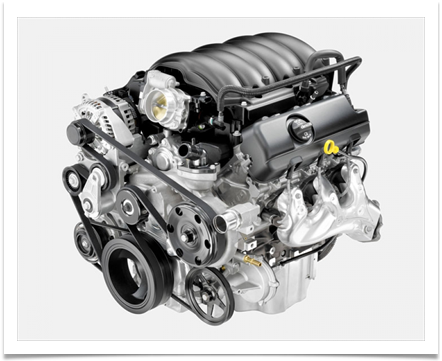
If you’re looking for a Maserati M156 3.0L V6 engine for sale, you already know this isn’t an ordinary engine swap. The car is special, the engine is complicated, and a new one from a dealer costs a figure that makes most owners go quiet for a minute. The good news is that a tested used or rebuilt engine can put a Quattroporte, Ghibli or Levante back on the road for a lot less than a new engine or a new car.
The catch is that these engines don’t forgive neglect, and a lot of the cars have lived hard lives in traffic or been serviced on the cheap. A tired engine can look perfectly shiny on a stand. So you need to know what you’re buying, and who you’re buying it from.
We’re NJ Global Auto Parts. We sell used and rebuilt engines and ship them to customers around the world. This guide is what we tell people when they ask us about a Maserati M156 3.0L V6 engine for sale: what the name actually means, the specifications, the cars it fits, the checks we do, the known problems, pricing, shipping and fitting. Jump to the parts you need.
What “M156” Means on a Maserati M156 3.0L V6 Engine for Sale
This trips up a lot of people, so let’s get it out of the way. M156 is Maserati’s project code for the sixth-generation Quattroporte, launched in 2013. It isn’t strictly an engine code. When people say “Maserati M156 3.0L V6”, they mean the 3.0 litre twin-turbo petrol V6 that went into that car, and the same engine family went into the Ghibli and the Levante.
The engine was developed by Maserati and built by Ferrari at Maranello. It’s a 60-degree V6 with direct injection and two turbochargers, and it’s been sold in several power levels. It’s a smooth, strong engine with a proper Italian voice once it’s on boost.
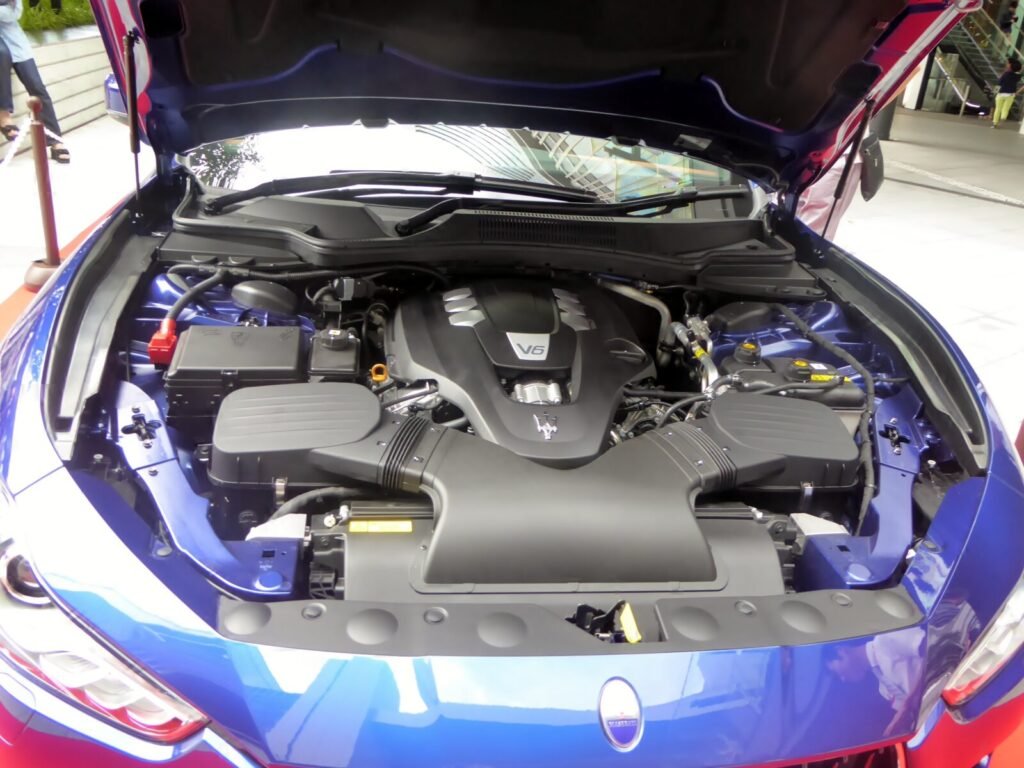
You’ll often see another M156 in engine listings too: the Mercedes-AMG M156, a 6.2 litre V8. It has nothing to do with the Maserati. If that’s actually the engine you need, see our Mercedes-AMG M156 and M159 engines instead. For the car itself, the Maserati Quattroporte VI page gives a clear overview.
Maserati M156 3.0L V6 Engine for Sale: Full Specifications
These are the figures people ask us for most. Output depends on the model, market and year.
| Engine | 3.0 litre twin-turbo petrol V6 (Ferrari-built) |
| Layout | 60-degree V6 |
| Displacement | 2,979 cc (3.0 L) |
| Bore x stroke | 86.5 mm x 84.5 mm |
| Block and heads | Aluminium |
| Valvetrain | DOHC, 24 valves, variable cam timing |
| Fuel system | High-pressure direct injection |
| Forced induction | Twin turbochargers with intercooling |
| Compression ratio | About 9.7:1 |
| Power, base versions | About 243 kW (330 PS), later about 257 kW (350 PS) |
| Torque, base versions | About 500 Nm |
| Power, S versions | About 301 kW (410 PS), later about 316 kW (430 PS) |
| Torque, S versions | About 550 Nm to 580 Nm |
| Fuel | Petrol |
The base and S engines look almost identical from the outside, but they differ in turbos, software and some internal parts. When we quote a Maserati M156 3.0L V6 engine for sale, we tell you the exact engine number, which car it came from, the year and the power version, so you can match it to your car properly.
Which Maserati Models Use This V6
The 3.0 twin-turbo V6 went into three main model lines:
- Quattroporte VI (M156), from 2013: base, S and S Q4 versions, and later GranLusso and GranSport trims.
- Ghibli (M157), from 2013: base, S and S Q4. The Maserati Ghibli M157 page covers the model history.
- Levante (M161), from 2016: base and S versions of the SUV.
Rear-wheel-drive and Q4 all-wheel-drive cars have different sumps and some different external parts, and later cars have updated electronics. Two engines that look the same can still need different parts to fit. Send us your VIN and we’ll find the Maserati M156 3.0L V6 engine for sale that matches your car.
Not to Be Confused With: Diesel, 2.9 and Nettuno
There are a few other Maserati-related V6 engines that get mixed up with this one.
The 3.0 V6 diesel. Quattroporte, Ghibli and Levante were also sold with a 3.0 turbo diesel V6 built by VM Motori. Same body, completely different engine. Not interchangeable.
The Alfa Romeo 2.9 V6. The Giulia and Stelvio Quadrifoglio use a 2.9 twin-turbo V6 that’s related in concept but is its own engine. It isn’t a swap for your Maserati.
The Nettuno. The newer Maserati 3.0 V6 used in the MC20 and later models is a different design with its own combustion system. Again, not a swap.
When you’re looking at any Maserati M156 3.0L V6 engine for sale online, check the engine number and the donor car, not just “3.0 V6 Maserati” in the title. That one photo saves a lot of grief.
7 Checks We Make on Every Maserati M156 3.0L V6 Engine for Sale
A clean engine cover tells you very little. These are the checks we make and the questions you should ask any seller.
1. Engine Number, Power Version and Donor Car
We photograph the engine number and record the donor car, year, drivetrain and power output. That tells us which cars the engine suits and what external parts it needs. If a seller won’t send this, look elsewhere.
2. Compression and Leak-Down
We test all six cylinders and compare the readings. Even numbers are what you want. A low cylinder can point to valve, ring or head gasket trouble, and on a twin-turbo engine you want to know about it before you pay. We share the results for every Maserati M156 3.0L V6 engine for sale we list.
3. Timing Chains and Cam Phasers
This engine uses timing chains with variable cam timing on the heads. Worn chains, tensioners or phasers can cause rattles at start-up and timing fault codes. We check for slack, look at the history where we have it and listen on engines we can run.
4. Turbochargers and Wastegates
We check both turbos for shaft play and oil on the compressor side, and we check the wastegate actuators and linkages, which can rattle and wear. We also look at the oil and coolant feed lines to the turbos, which are common leak points.
5. Carbon Build-Up and Intake Condition
Like most direct-injection engines, this V6 can build carbon on the intake valves, especially on cars that spent their lives in slow traffic. Where we can, we look at the ports and valves. Heavy carbon isn’t a deal breaker, but it’s worth knowing about.
6. Oil and Coolant Leaks
Cam cover gaskets, turbo lines, the water pump and coolant pipes are the usual places to look. We note every leak we find so you can plan the fix while the engine is out, which is always easier.
7. What’s Included
A complete engine with turbos, manifolds, injectors, fuel pumps and wiring is worth a lot more than a long block. We list exactly what’s fitted to each Maserati M156 3.0L V6 engine for sale and show it in the photos so you can compare prices fairly.
Common Problems With the Maserati 3.0 V6
Knowing the weak points helps you judge any Maserati M156 3.0L V6 engine for sale and look after the one you buy.
- Timing chain and phaser wear. Often linked to long oil change intervals and short trips.
- Wastegate rattle. Worn actuators and linkages on the turbos, especially on higher-mileage cars.
- Oil leaks. From the cam covers and turbo oil lines.
- Coolant leaks. From the water pump, hoses and coolant pipes around the V.
- Carbon build-up. On the intake valves, which causes rough running and misfires over time.
- Ignition coils and plugs. Hard-working parts on a turbo engine and a common cause of misfires.
- Turbo failure. Usually after oil starvation or old, broken-down oil.
Our earlier M156 V6 buying article covers pricing and features in more detail, if you want a second read.
Does Your Maserati Really Need a New Engine?
Before you spend serious money, be certain the engine is actually finished. Plenty of these cars that run badly have faults around the engine, not inside it.
These signs usually mean a replacement makes sense:
- Low compression on one or more cylinders.
- A knock from the bottom end.
- Coolant in the oil or oil in the coolant.
- Valve or piston damage after a timing failure.
- Metal in the oil or filter.
Misfires, warning lights and limp mode are often coils, plugs, sensors, boost leaks or wastegate trouble. A good Maserati specialist can tell the difference. If the engine really is done, that’s when a Maserati M156 3.0L V6 engine for sale is the sensible route. Send us the diagnosis and we’ll suggest the right engine and what’s worth keeping from your old one.
Used, Rebuilt or Long Block?
Used. A tested engine from a donor car, sold as described. For most owners, a used Maserati M156 3.0L V6 engine for sale is the best balance of cost and risk.
Rebuilt. A rebuilt Maserati M156 3.0L V6 engine for sale has been stripped, measured and reassembled with new wear parts where needed, often including timing parts. It costs more, but you start with a known engine.
Long block. The core engine without some ancillaries. A good choice if your turbos, injectors and accessories are healthy.
See what’s available now on our Maserati M156 3.0L V6 engine product page.
What Affects the Price of a Maserati M156 3.0L V6 Engine for Sale
Everyone asks about price first. Here’s what moves it:
- Power version. S engines usually cost more than base engines.
- Mileage and condition. Even compression, clean oil and quiet chains push the value up.
- Completeness. Turbos, injectors, fuel pumps and wiring are worth a lot on this engine.
- Drivetrain. Q4 and rear-drive engines differ in some parts.
- Used or rebuilt. A rebuild covers parts and many hours of skilled labour.
- Freight. Where it’s going matters, so we quote shipping before you pay.
A suspiciously cheap Maserati M156 3.0L V6 engine for sale usually has a reason. It could be missing the turbos, it could have a timing problem, or it could be a diesel listed carelessly. Ask for photos and the engine number before you talk money.
Buying a Maserati M156 3.0L V6 Engine for Sale From Overseas
Most of our buyers are far from us. Paying for an expensive engine you can’t touch feels risky, and that’s a fair feeling. Here’s how to make it safer with any seller.
Ask for photos of the actual engine from several angles, including the engine number. Ask for test results in writing. Get the freight cost and delivery point confirmed before you pay. And find out what happens if the engine arrives damaged. We do all of that as a matter of routine.
Many of our customers are workshops ordering a Maserati M156 3.0L V6 engine for sale for a client’s car. They need everything clear on paper, and private owners get the same treatment. Speak to your specialist before you order. They can confirm the diagnosis, check which version your car needs and tell you which parts they’ll reuse.
Shipping a Maserati M156 3.0L V6 Engine for Sale Worldwide
We ship every Maserati M156 3.0L V6 engine for sale worldwide. Each one goes out drained, with openings capped, strapped to a pallet or crated, and with the turbos, sensors and wiring protected. The fuel pumps and injectors are sealed against dirt.
Sea freight is the usual choice because it costs much less. Air freight is there when the car needs to be back quickly. We confirm the cost and the arrival port or airport before you commit.
You’ll get the commercial invoice, packing list and bill of lading or airway bill. Your customs broker handles duty and taxes at your end. Engines are classified under the HS system run by the World Customs Organization, so the paperwork is standard. Read our shipping policy for details and our refund and returns policy for what happens if anything arrives damaged.
Fitting Tips From Maserati Specialists
These are the things a good specialist does when fitting a Maserati M156 3.0L V6 engine for sale:
- Find out why the old engine died. If a turbo failed, clean the intercoolers and charge pipes before the new engine goes in. Debris from a failed turbo can kill a new one.
- Replace wear parts while it’s out. Coolant hoses, turbo oil and coolant lines, cam cover gaskets and engine mounts are far easier to reach now.
- Fresh plugs and check the coils. Cheap and worth it.
- Match the software. Make sure the engine version suits the car’s engine computer. Use proper diagnostic equipment after the first start.
- Bleed the cooling system carefully. Air pockets cause overheating and warning lights.
- Use the right oil and do an early first oil change after the engine has settled in.
Looking After the V6 Once It’s Running
This engine rewards careful ownership. A few habits make a big difference.
- Change the oil more often than the longest interval allows, especially if the car does short trips.
- Warm it up gently. Don’t use full boost until the oil is warm.
- Let the turbos cool with a short idle after hard driving.
- Keep an eye on the coolant level. Small leaks become big problems.
- Listen at cold start. A chain rattle is cheaper to fix early.
- Take it for a proper run now and then. Endless short trips are hard on direct-injection engines.
Treat it like that and a Maserati M156 3.0L V6 engine for sale you buy today has every chance of lasting.
Is It Worth Fixing a High-Mileage Maserati?
This is a fair question, and we’d rather you asked it before you buy. Maserati values drop steeply, so on some older, high-mileage cars the cost of an engine can be close to what the car is worth. It doesn’t mean you shouldn’t do it. It means you should look at the whole car first.
If the body is straight, the gearbox shifts cleanly, the suspension and electrics are in good order and you love the car, then a good engine is money well spent. You’ll end up with a car you know, with a known engine, for far less than buying another one with unknown history. If the car has lots of other problems waiting, it’s worth getting a proper quote for those too before you commit to a Maserati M156 3.0L V6 engine for sale.
We’re happy to talk that through with you honestly. Tell us about the car and we’ll give you a straight view, even if the answer is that a used long block is enough and you don’t need a complete Maserati M156 3.0L V6 engine for sale at all.
Other Things to Check While the Engine Is Out
Pulling the engine on one of these cars is a big job, so it pays to look at the parts around it while there’s room to work. A good specialist will usually suggest a few of these, and they’re worth listening to.
The gearbox. Most of these cars use an eight-speed automatic. Check the fluid condition and ask whether it’s ever been serviced. A fluid and filter change at this point is cheap compared with a gearbox problem later.
Engine and gearbox mounts. The mounts on a heavy twin-turbo car wear out, and tired mounts cause knocks and vibration that owners often blame on the new engine.
Radiators and intercoolers. If the old engine overheated, the radiator may be partly blocked. If a turbo failed, the intercoolers and pipes may hold oil and metal. Either can hurt a fresh Maserati M156 3.0L V6 engine for sale in its first few weeks.
The exhaust and catalytic converters. A failed engine that burned oil or misfired for a long time can damage the cats. Check them before you finish the job, not after the warning light comes back.
None of this has to be done at once, but a quick inspection is free while everything is apart. We’d much rather you spend a little on these checks than have a good Maserati M156 3.0L V6 engine for sale let down by a tired part it depends on. If you need advice on any of it, just ask when you order your Maserati M156 3.0L V6 engine for sale.
Questions to Ask Before You Pay for a Maserati M156 3.0L V6 Engine for Sale
- Which car, year and power version did it come from?
- Can I see a photo of the engine number?
- What were the compression readings?
- Any timing chain noise or phaser codes?
- Are both turbos included, and what state are the wastegates in?
- Is it rear-drive or Q4 spec?
- Is it used, rebuilt or a long block?
- What does the freight quote include?
We answer every one of these for each Maserati M156 3.0L V6 engine for sale on our site. If we don’t know something, we tell you.
Other Maserati and Italian Engines We Supply
If your car has the older V8, look at the Maserati M145 V8 engine and our M145 buying guide. For Ferrari V8 power, read our Ferrari F136FB guide. You can browse our full used engines range any time.
For official model information, the Maserati website is the place to go.
Why Buy From NJ Global Auto Parts
We match each Maserati M156 3.0L V6 engine for sale to your VIN before you pay. You get photos of the actual engine, a written summary of our checks and a clear list of what’s included, flaws and all. We quote freight up front, wherever you are.
If we don’t have the right engine for your car, we’ll say so. We’d rather lose a sale than ship the wrong engine. Read more about us or browse the shop.
Frequently Asked Questions
Is the M156 an engine code?
Not really. It’s the project code for the sixth-generation Quattroporte. People use it to mean the 3.0 twin-turbo V6 in that car.
How much power does it make?
About 243 to 257 kW (330 to 350 PS) in base form and about 301 to 316 kW (410 to 430 PS) in S form.
Is it the same engine as the Mercedes-AMG M156?
No. That’s a 6.2 litre V8. Completely different engine.
Is your Maserati M156 3.0L V6 engine for sale used or rebuilt?
We offer both. Each listing and quote says which.
Do you ship to my country?
Yes. We ship worldwide by sea or air, with freight quoted before you pay.
What if it arrives damaged?
Contact us right away with photos. We’ll work it out with you using our inspection record and your quote.
A Maserati M156 3.0L V6 engine for sale should come with real photos, honest notes and a seller who understands these cars. That’s what we try to give every buyer. Send us your VIN through the contact page, tell us about your car, and we’ll tell you what we have and what it will cost to get it to you.